
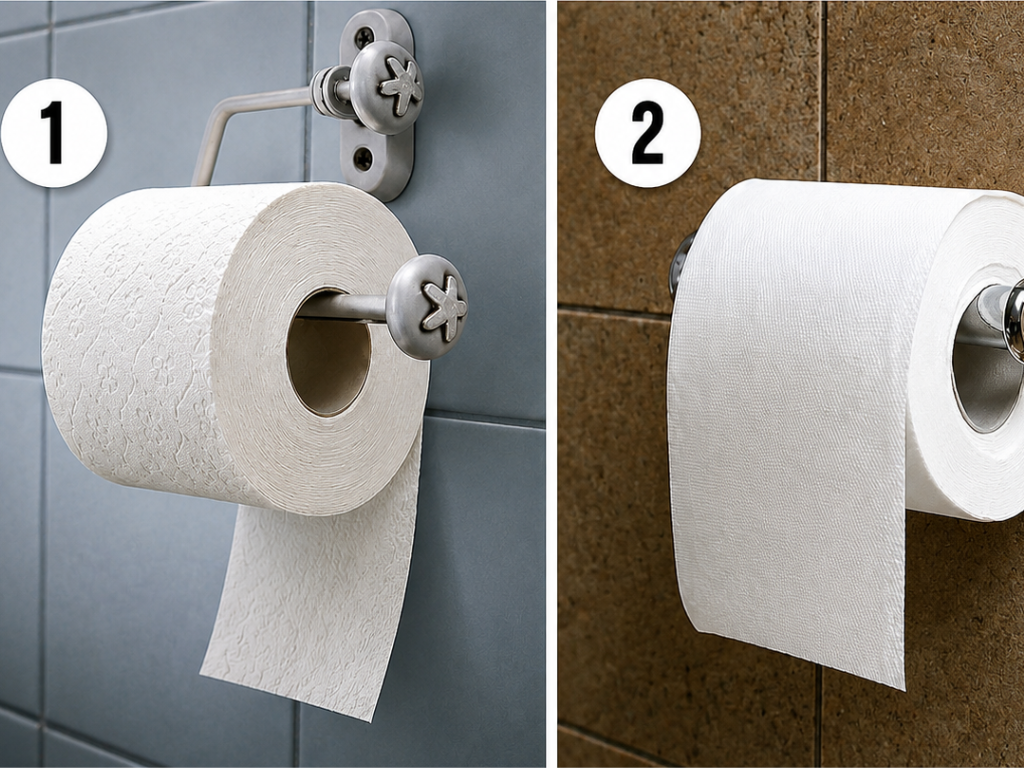
An Everlasting Debate
We have all experienced this situation: walking into a loved one’s bathroom and immediately noticing that the toilet paper roll is placed “the wrong way.” It seems like a trivial detail, yet it can irritate more than one might expect. Since the invention of toilet paper on a roll, two camps have stood firm in households across the world: those who prefer the paper to hang over the roll, and those who want it hanging against the wall.
Each side has its own set of arguments, defended with strong conviction.
Why Choose the Paper Hanging Over the Roll?
For those who position the roll with the paper hanging over the front, here are the main reasons justifying this choice:
– Hygiene: only the sheet you use is touched, without the roll rubbing against the wall.
– Ease of Use: the paper is immediately visible, and it’s easy to pull with one hand.
– The “Hotel” Effect: the small triangular fold, carefully made by cleaning staff to signal that everything has been tidied, can only be formed when the paper hangs over the front.
It is difficult to dispute the validity of these points.

Reasons for Hanging the Paper Against the Wall
The opposing camp also has strong and reasonable arguments:
– A Cleaner Look: the paper is hidden behind the roll, giving a more minimalistic and neat visual appearance.
– Protection from Children and Pets: a playful cat or curious child will have a much harder time unrolling the paper when it is installed with the sheet against the wall.
– Less Waste: some are convinced that this position subconsciously reduces overuse of the paper.
These solid arguments deserve consideration depending on the family or domestic environment.
A Century-Old Patent Sheds Light on the Debate
The history of toilet paper reveals a fascinating fact. In 1891, an American inventor named Seth Wheeler filed an official patent for the perforated toilet paper roll. This patent, referenced as US465588, includes very precise illustrations detailing how the product should be used.
In these drawings, the paper is clearly shown hanging over the top of the roll, toward the front.
Wheeler had thought of everything: to easily tear the sheet along the perforations, the paper must remain visible and accessible. Therefore, the “paper hanging over the front” position is not merely a preference—it was the inventor’s original design choice.
So, Who Really Holds the Truth?
This patent does not dictate an absolute rule or an obligation to follow in every bathroom. It is not a universal law, merely a historical and technical indication from the inventor himself.
However, this insight provides a strong argument for those who have always supported the paper hanging over the roll. On the other hand, if you share your home with children or mischievous pets, placing the paper against the wall remains a perfectly reasonable and adapted decision.
In all other cases, history officially sides with you since 1891.
The next time someone places the toilet paper roll in what you consider the “wrong way,” you will know exactly what to tell them.
