
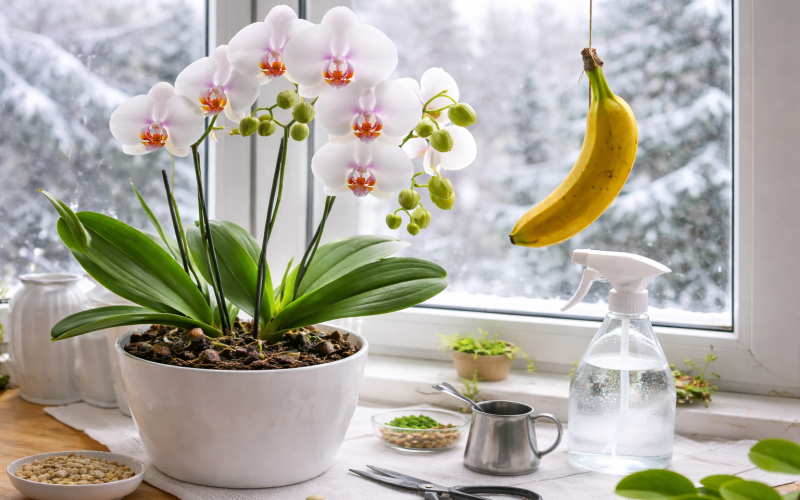
In the depths of winter 2026, your orchids may look frozen in time, while those in florist shops seem to burst with flowers. This difference is not a matter of luck, but the result of a carefully calibrated balance of light, temperature, and care.
Key Takeaways at a Glance
In heated homes across Germany, Phalaenopsis orchids given as Christmas gifts often slow down during winter, while the same plants continue blooming beautifully in florist shops.
Professionals rely on a precise balance of winter light, minimal watering, and a controlled environment to stimulate a new flowering cycle.
An unusual trick involving a banana, along with several common winter mistakes to avoid, can either speed up this delicate process or stop it entirely.
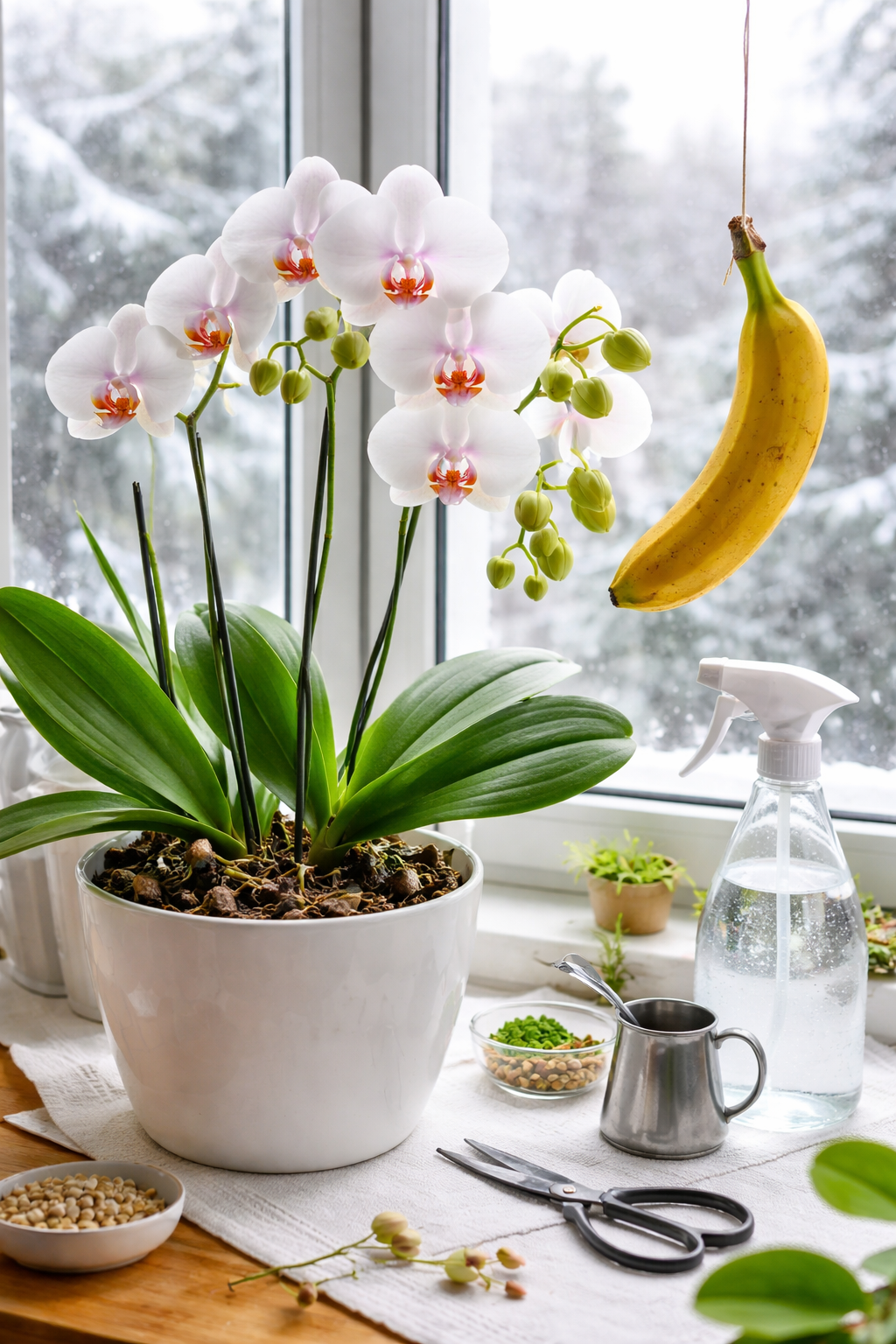

In many homes, winter 2026 leaves Christmas-gifted orchids looking miserable: bare stems, limp leaves, and no sign of a new flower spike. It is easy to assume the plant is beyond saving. Meanwhile, florists and garden centers display the very same Phalaenopsis varieties covered in flawless blooms.
Their secret is not a miracle fertilizer, but a precisely controlled environment: targeted light, carefully managed watering, and above all a nighttime temperature cue. When this subtle difference between day and night temperatures is recreated at home, a spectacular winter bloom becomes possible—sometimes within just a few weeks.
Why Orchids Stop Blooming in Winter
Contrary to popular belief, a Phalaenopsis without flowers is not dead, but resting. In permanently heated rooms at around 21 °C, the plant lacks the essential contrast between day and night temperatures. At the same time, winter light levels are far lower than in summer. If the orchid is placed too far from an east- or southeast-facing window, it no longer receives the light signal needed to initiate new flower spikes.
Another frequent mistake is overwatering. Out of concern, many people water their orchid too often, leave water standing in the saucer, and soak the growing medium. The result is root rot and a complete absence of blooms. Professionals water only every ten to fifteen days in winter, use low-lime water at room temperature, briefly soak the pot, and allow it to drain fully. Special orchid fertilizer is consistently withheld until spring.
Light, Water, and the Professionals’ Temperature Technique
To trigger flowering, florists place the plant directly behind a bright east- or southeast-facing window, filtered by a light curtain. The goal is ten to twelve hours of brightness per day; in darker rooms, a small grow light can help. It is crucial to keep the pot away from radiators, which dry out the air and damage buds.
The decisive factor is the temperature difference. During the day, the Phalaenopsis orchid remains at 20 to 22 °C. In the evening, it is moved to a cooler room with a steady temperature of 16 to 18 °C. Temperatures below 15 °C and cold drafts must be avoided. This difference of four to six degrees, repeated over two to three weeks—and sometimes up to six—mimics cooler tropical nights and activates the flowering mechanism.
The Hanging Banana and Common Winter Mistakes
As an extra stimulus, some enthusiasts use the hanging banana trick. A ripe yellow banana with small brown spots is suspended 30 to 40 cm above the plant in a bright room at 18 to 21 °C. As it ripens slowly, it releases ethylene, a plant hormone that can encourage flower formation in many orchids. This method should last 48 to 72 hours, with a maximum of three to five days, and should not be repeated more than once every two to three weeks.
However, this trick does not replace the basics. Without sufficient light, without a day–night temperature contrast, and without careful watering, the banana has no effect. Florists are especially careful in winter to avoid mistakes: placing pots on radiators, exposing plants to cold drafts near doors, using ice-cold water or ice cubes in the growing medium, or leaving rotting fruit nearby. Positive signs are easy to recognize: firmer leaves, roots turning green, and a small, hard nub at the base—the promise of a new flower spike.
