
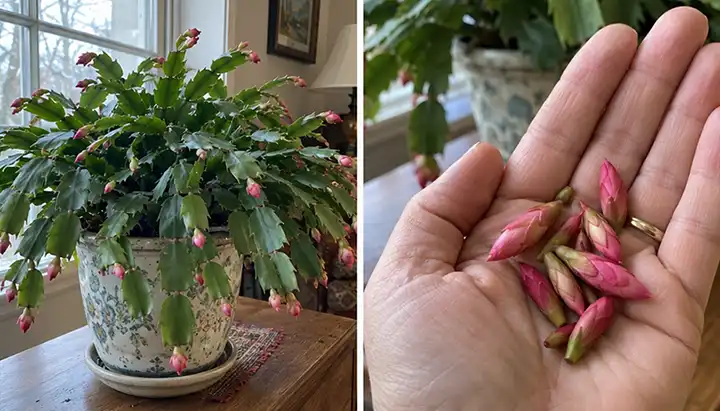
If your Christmas cactus has remained healthy throughout the year but produced very few flowers last winter, October might be the month that changes everything.
Many mistakenly believe that more fertilizer, increased watering, or a sunnier window are needed to see vibrant blooms during the holiday season. In reality, the secret is often much simpler: a proper combination of extended darkness, cool temperatures, and controlled watering during the fall.
The Christmas cactus is sensitive to seasonal changes. As the days shorten and the nights grow cooler, the plant receives signals that stimulate bud formation.
October plays a crucial role because it is when the plant prepares its buds ahead of the winter holiday period.
A few subtle adjustments during this month can make all the difference between a cactus covered in colorful blossoms and one that produces only green stems.
Here is what your Christmas cactus needs in October, why these changes are vital, and how to avoid mistakes that prevent flowering.
The Importance of October for the Christmas Cactus
The Christmas cactus belongs to the genus Schlumbergera, a group of tropical cacti native to the forests of southeastern Brazil.
Unlike desert cacti, they naturally grow in humid environments, often perched on trees or amid organic debris on rocky terrain.
They prefer filtered light, well-drained substrate, and more consistent humidity than desert cacti tolerate.
Their blooming cycle is also distinctive.
Christmas cacti are short-day plants, meaning that flower bud formation depends on uninterrupted darkness during each night.
Cool temperatures also play a crucial role in triggering flowering.
During summer, the plant focuses its energy on growing green segments. As autumn approaches, shorter days and cooler nights signal it to switch to flower bud production.
This explains why a healthy cactus can grow vigorously yet fail to bloom if appropriate fall conditions aren’t met.
These five care tips for October encourage abundant and vibrant flowering.
1. Provide Your Christmas Cactus with Long, Uninterrupted Nights of Darkness
Controlling nighttime light exposure is a fundamental step to encourage flowering of the Christmas cactus.
In autumn, these plants require about 12 to 14 hours of continuous darkness each night, with some varieties benefiting from even longer periods.
The darkness must be uninterrupted.
A cactus placed in a room with evening light, even dim, may receive enough daylight but will experience too much artificial light at night, disrupting bud formation.
Even typical household lighting can hinder blooming.
How to Ensure Proper Darkness
Place the plant where it will not be disturbed through the night.
Some suitable options include:
- A guest room unused at night
- A cool room free of nighttime light
- A naturally dark window away from streetlights
- A ventilated closet used only during the dark period
If necessary, cover the plant with an opaque, breathable fabric that is flexible enough not to crush the stems.
Remove the cover each morning.
Avoid sealed plastic bags that would suffocate the plant.
A Simple Daily Routine to Follow
For an indoor upright cactus, try this schedule:
6:00 PM: place the plant in total darkness.
8:00 AM: return it to soft, indirect morning light.
This creates approximately 14 hours of darkness and 10 hours of light.
Maintain this cycle for about 4 to 6 weeks, until flower buds form.
The exact timing varies depending on the variety and ambient temperature.
The Importance of Consistency
The plant responds to repeated light and dark cycles.
An interruption, such as leaving lights on late one evening, can delay bud formation.
Consistency is more effective than complex techniques.
Gardening tip: it is often easier to keep the plant in a naturally cool and dark room than to move or cover it every night.
2. Maintain Cool Nighttime Temperatures
Temperature is the second key factor influencing flowering.
Christmas cacti develop buds more readily when nights are cooler than days.
Recommended fall temperature range:
Day: 16–21°C (60–70°F)
Night: 13–18°C (55–65°F)
Optimal flowering conditions: around 13°C (55°F)
At approximately 13°C, some varieties can bloom even without strictly controlled darkness.
However, prolonged exposure to excessively low temperatures can damage the plant.
Never deliberately expose your cactus to frost.
Where to Place Your Cactus
An unheated but frost-free room works perfectly.
A bright room with cool nights is also suitable.
Avoid placing it:
- Above a radiator
- Near a heating vent
- Close to a fireplace
- In a room too warm at night
- Against a frost-covered window
- In a cold draft
Why Too Warm a Room Can Prevent Flowering
If your cactus spends its nights in a room over 21°C, it will struggle to form buds.
It will remain green and vigorous but focus on vegetative growth instead of blooming.
If your plant has not flowered for several years, check the nighttime temperature.
A slightly cooler location may encourage beautiful flowering.
3. Reduce Watering Without Letting the Plant Dry Out Completely
October is also the time to adjust your watering frequency.
During active summer growth, your Christmas cactus requires more regular watering.
With decreased vegetative activity in autumn, water needs often diminish.
However, this does not mean stopping watering altogether.
These cacti are tropical plants, not desert cacti.
Letting the roots become too dry stresses the plant and often causes budding flower loss.
How to Water in October
Before watering, check the substrate by inserting your finger about 2–3 cm deep.
If the surface is dry, assess the plant’s water needs.
Pour water slowly onto the substrate.
Moisten the soil evenly.
Allow excess water to drain out of the pot’s holes.
Empty the saucer to prevent waterlogging.
Wait until the surface starts to dry before watering again.
Don’t follow a rigid schedule.
Watering frequency varies based on temperature, pot size, ambient humidity, and substrate type.
Signs of Overwatering
- Substrate remains wet for several days
- Stems are soft despite wet soil
- Yellowing or damaged stem segments
- Moldy smell emanating from the pot
- Soft or rotten roots
Excess watering encourages root rot, a common issue with these plants.
Signs of Underwatering
- Wrinkled stem segments
- Flaccid growth
- Very dry substrate pulling away from pot edges
- Early drop of flower buds
The goal is to maintain slightly reduced moisture without extreme dryness.
4. Adjust Fertilization for Autumn
Many gardeners continue fertilizing their Christmas cactus year-round.
However, autumn is not the active growth season.
In spring and summer, fertilizer promotes stem growth.
In October, the plant prepares to bloom.
Too much nitrogen encourages green growth instead of bud formation.
Should You Stop Fertilizing in October?
For most healthy cacti, stopping fertilizer in autumn is an easy and reasonable solution.
The plant can draw on reserves accumulated during the growing season.
Some recommendations suggest a light, diluted, low-nitrogen feed, but this is not necessary for all plants.
If your cactus has been regularly fertilized and looks vigorous, a special fertilizer is usually not needed to induce flowering.
When to Resume Fertilizing?
A practical schedule is:
Spring: resume light fertilization at the onset of active growth.
Summer: fertilize periodically with balanced, diluted fertilizer.
Early autumn: reduce or stop regular feeding as blooming approaches.
Winter: avoid heavy fertilization during flowering or rest periods.
Always follow the manufacturer’s instructions.
Too much fertilizer can damage roots and increase salt buildup in the substrate.
Keep in mind: fertilizer cannot replace appropriate darkness and temperature conditions.
5. Monitor Flower Buds and Avoid Sudden Changes
After several weeks of ideal autumn conditions, you will see small buds appear at the tips of green segments.
Initially, they are very small, often round or pointed.
As they grow, they elongate and gradually display the colors of future flowers.
At this stage, careful handling is essential.
What to Do When Buds Appear?
You can usually stop the strict darkness regimen.
Place the plant in a bright spot with indirect light and stable temperatures.
Continue moderate, attentive watering.
Avoid major disruptions to the plant’s environment.
Do Not Move the Plant Frequently
Christmas cacti often lose buds due to sudden changes in:
- Temperature
- Light
- Humidity
- Watering
- Location
If you want to move your plant to a warmer room, do so gradually and avoid repeated relocations.
To minimize risks, keep the plant in a stable place until the first flowers open.
Keep It Away from Heat Sources
Hot, dry air from radiators and heating vents stresses the plant.
Also protect it from cold drafts.
The more stable the environment, the better the chances for buds to thrive. <Cite refs={[“turn363283search3″,”turn363283search7”]}/>
How Long Does It Take for a Christmas Cactus to Bloom?
Flowering usually does not occur immediately after care changes.
Bud formation takes time.
Under good conditions, the first buds appear after approximately 4 to 8 weeks.
Development and flower opening then require additional time.
For example, a cactus exposed to favorable conditions from early October may form buds in November and bloom in late November or December.
The exact timing depends on:
- The plant variety
- Nighttime temperatures
- Duration of darkness
- Plant maturity
- Overall health
- Previous growing conditions
Some species bloom naturally earlier.
Also, a plant sold as a Christmas cactus may sometimes be a Thanksgiving cactus, which often blooms earlier.
Christmas Cactus or Thanksgiving Cactus: How to Identify Your Plant
Many plants sold as Christmas cacti are actually Thanksgiving cacti.
Both belong to the genus Schlumbergera and require similar care.
They differ, however, in appearance and blooming period.
Christmas Cactus — Schlumbergera × buckleyi
The true Christmas cactus has stem segments that are more rounded with wavy edges.
It generally blooms later in the holiday season.
Thanksgiving Cactus — Schlumbergera truncata

The Thanksgiving cactus is distinguished by pointed, serrated stem edges.
It often blooms in November.
Both types benefit from shorter days and cooler nights, making October care tips relevant to each.
What Is the Ideal Location for a Christmas Cactus in October?
Choosing the right spot greatly simplifies the process.
Prefer a bright daytime location with gentle, indirect light, and complete darkness at night.
Optimal Conditions
Light: filtered, bright daylight.
Nighttime temperature: around 13 to 18°C (55–65°F).
Daytime temperature: approximately 16 to 21°C (60–70°F).
Humidity: moderate, without excessive dryness.
Watering: allow surface to dry between waterings.
Drainage: pot with drainage holes and well-aerated, well-draining substrate.
An east-facing window shielded from hot afternoon sun in a cool room is ideal.
Avoid rooms where artificial lights stay on late into the evening.
Simple October Care Schedule
October 1–7: Check plant health, drainage, light, and nighttime temperature.
October 8–14: Establish long, dark, consistent nights with cooler temperatures.
October 15–21: Maintain routine, water only as needed, stop heavy fertilization.
October 22–31: Keep a stable environment, monitor stem tips for first flowers.
November: Continue favorable conditions until buds form; avoid sudden changes.
December: Maintain consistent care and enjoy the flowers as they open.
This schedule provides a general framework, but blooming times can vary between plants.
If buds are already present in early October, prioritize stability rather than attempting to re-establish a strict darkness regimen.
Seven Common Mistakes That Prevent Christmas Cactus from Flowering
1. Leaving Lights On at Night
A cactus placed in a living room lit until midnight won’t get enough darkness.
Place it in a room that stays dark after sunset.
2. Keeping the Plant Too Warm
High nighttime temperatures impede bud initiation.
Place your plant in a cooler room in autumn.
3. Overwatering
Excessively wet substrate can cause root diseases and stress the plant.
Allow the top layer to dry slightly between waterings.
4. Letting the Substrate Become Completely Dry
Severe dryness also causes stress.
Christmas cacti require more moisture than desert cacti.
5. Applying Too Much Fertilizer
Excess nutrients in autumn promote vegetative growth at the expense of flowering.
Reduce or stop fertilization as winter approaches.
6. Moving the Plant After Buds Appear
Sudden changes in temperature, light, or humidity cause bud drop.
Maintain a stable environment.
7. Repotting at the Wrong Time
Repotting in October disturbs roots and can jeopardize flowering.
Unless necessary (root rot, etc.), wait until after flowering or active growth resumes.
Why Is My Christmas Cactus Growing Leaves but Not Flowers?
This is a common question.
A cactus can produce green segments for years without blooming if it doesn’t receive the proper seasonal cues.
The most frequent causes are:
Too much nighttime light: insufficient long, continuous dark nights.
Too warm temperatures: nights too warm.
Overwatering: root stress caused by substrate moisture issues.
