
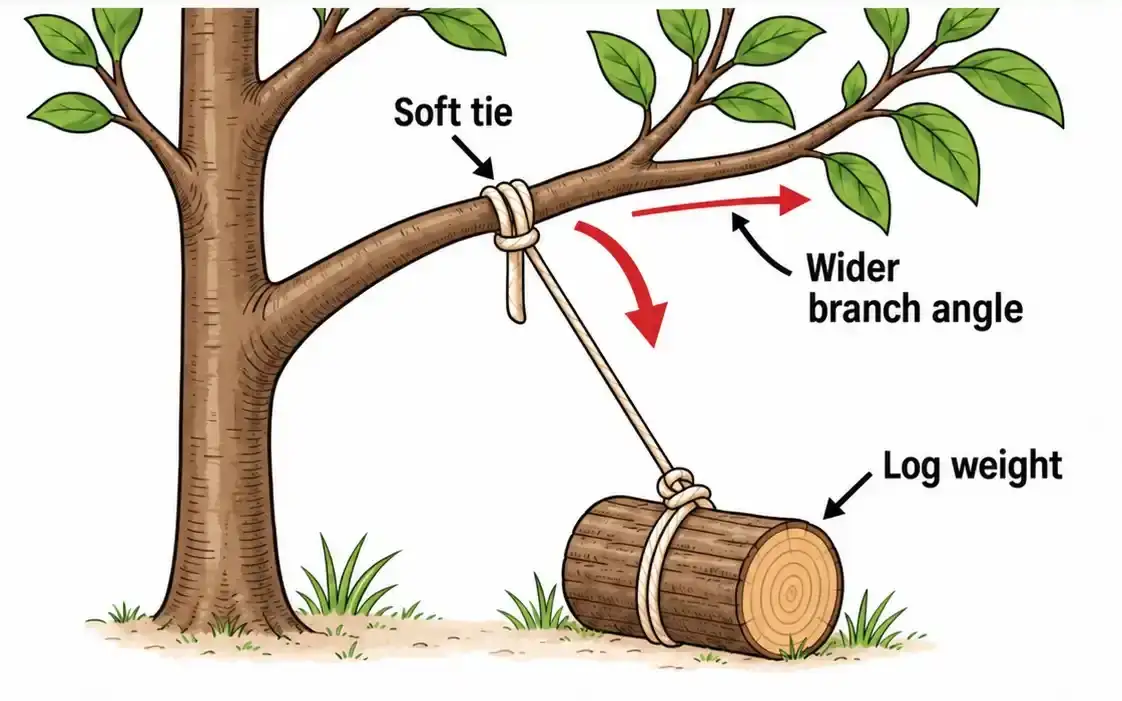
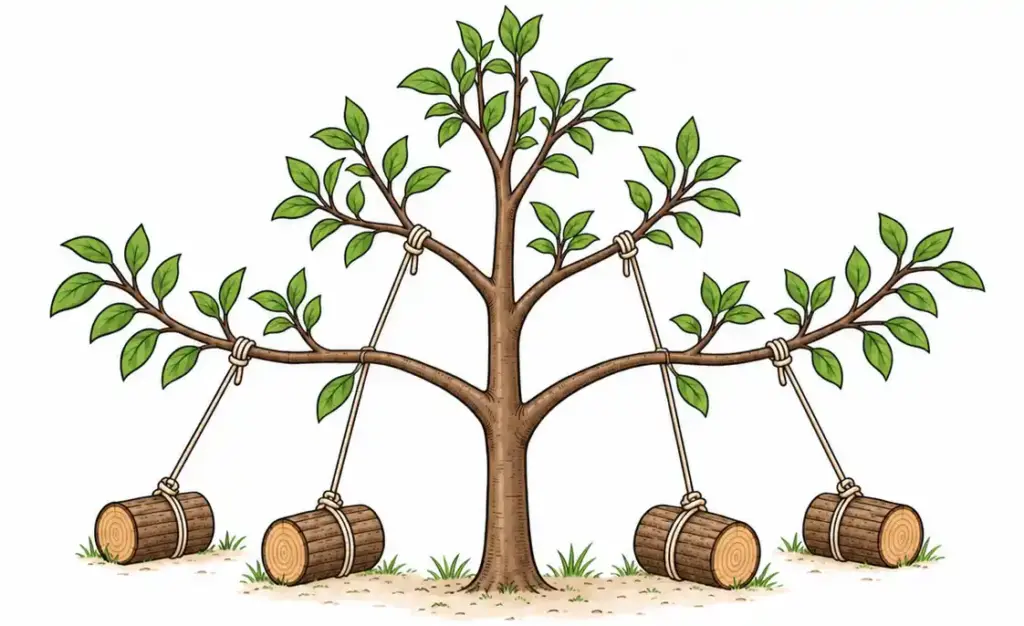
In managing a home orchard, one of the most effective techniques to encourage early and abundant harvests is known as branch bending or shoot spreading. As illustrated in the accompanying image, this method involves using weights or ties to gently pull down young branches that grow vertically. Physically altering the growth angle of a branch in relation to the main trunk profoundly influences the tree’s internal chemistry and structural strength, all achieved without the need for any pruning.
The Principle Behind the Technique
Fruit trees naturally tend to grow vertically, reaching upwards toward the sun. When a branch grows upward, the tree sends growth hormones to its tip, stimulating the production of wood and leaves rather than fruit. Additionally, sap flows very rapidly through these vertical shoots.
By bending the branch downward towards a more horizontal position, the rapid upward sap flow is slowed, and growth hormones are distributed more evenly along the entire length of the branch. This shift sends a signal to the tree to stop focusing growth solely on height and instead to convert leaf buds into fruit buds.
The Fundamental Benefits of This Method
Changing a branch’s angle from a narrow vertical “V” shape to a wider horizontal “U” shape provides several major advantages for the tree’s vigor and productivity.
Accelerated fruit production: Trees with horizontal branches typically bear fruit much earlier than those with upright branches. This hormonal balance change quickly triggers the formation of fruit buds.
Stronger structure: A narrow angle between the trunk and a branch is mechanically weak. The bark that grows in this tight space acts like a wedge that can easily split the branch under the weight of fruit or in strong winds. A wide angle creates a solid, durable wooden connection to the trunk.
Improved sun exposure: Opening up the tree’s center allows better light penetration to the lower and inner branches. Fruit development requires direct sunlight to develop proper color and natural sugars.
Optimized air circulation: Spreading branches apart facilitates wind passage through the foliage, which accelerates leaf drying after rain and helps limit fungal diseases.
Easier harvest: Keeping branches lower makes picking fruit simpler and safer, reducing the need for tall, risky ladders.
The Trees Best Suited for This Support Technique
Although this method benefits many species, it is especially effective for fruit trees that naturally grow very upright.
Apple trees: Especially varieties that tend to grow straight up and take longer to bear fruit.
Pear trees: Known for extremely vertical growth, pear trees benefit greatly from early branch spreading.
Plum trees: Plums require wide branch angles to support the heavy clusters of compact fruit.
Cherry trees: Sweet cherry trees often develop narrow and fragile forks that must be widened early to prevent branches from splitting later.
The Ideal Time to Attach and Weigh Down Branches
Branch bending is best performed in late spring or early summer, when the tree is actively growing, sap is flowing naturally, and the young wood remains flexible. Attempting to bend branches in the middle of winter, when the wood is frozen and brittle, will likely cause breakage. This technique is most suitable for relatively young branches, between one and three years old. Older, thicker branches are too rigid to bend safely.
Steps for Properly Bending Branches
To practice this support method safely and effectively, it is essential to follow specific steps to avoid damaging the bark or breaking branches.
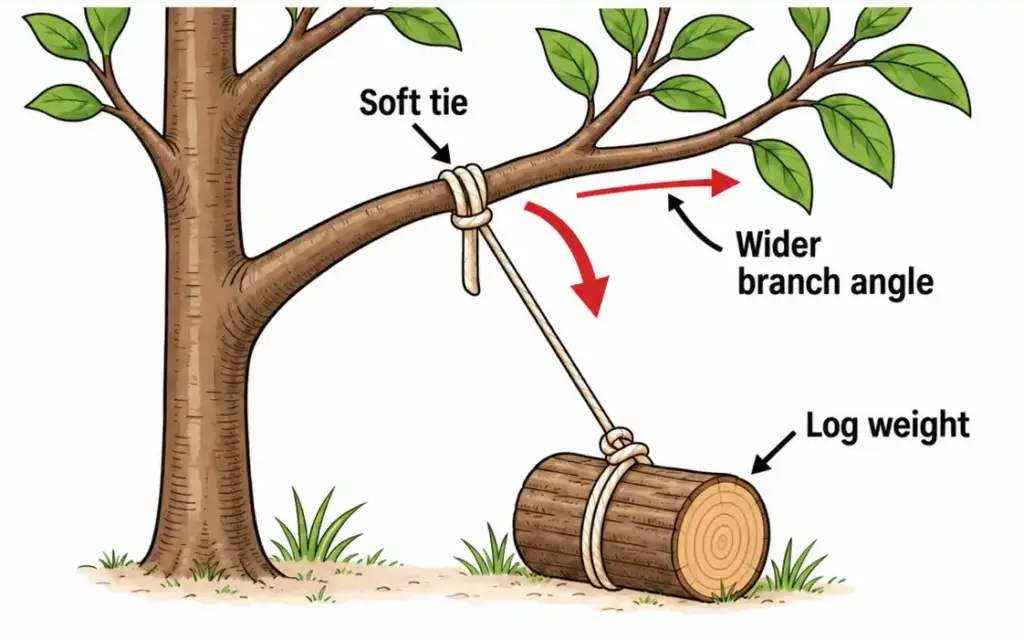
Choose the right materials: Avoid thin wires or bare strings placed directly on the tree, as they can cut into the bark and strangle the branch. Opt for flexible ties such as wide fabric straps, rubber tubing, or specialized tree bands. To apply tension, attach the other end to weights placed on the ground, wooden stakes inserted into the soil, or even at the base of the trunk.
Place the tie in the correct spot: Wrap the flexible tie around the middle of the branch. If placed too close to the trunk, the leverage will be insufficient to bend the branch properly. If too close to the thin tip, the branch may break or deform unnaturally.
Pull gradually: Gently incline the branch downward until you reach an angle of about 45 to 60 degrees relative to the trunk. Avoid pushing it completely flat or below horizontal as this weakens the branch excessively and encourages the growth of unwanted vertical shoots.
Secure the weight: Attach the rope to your chosen weight or stake, ensuring a steady tension. The weight should be heavy enough to stabilize the branch against the wind but not so heavy that it pulls the branch from the trunk.
Regularly check: Inspect the ties every few weeks. As the branch grows thicker, loosen the straps before they begin to cut into the bark or impede sap circulation.
Remove the ties: The branch will eventually adapt to its new position as the wood hardens. After a full growing season, in late summer or early autumn, you can remove the straps; the branch will remain spread and will be ready to produce abundantly.
