
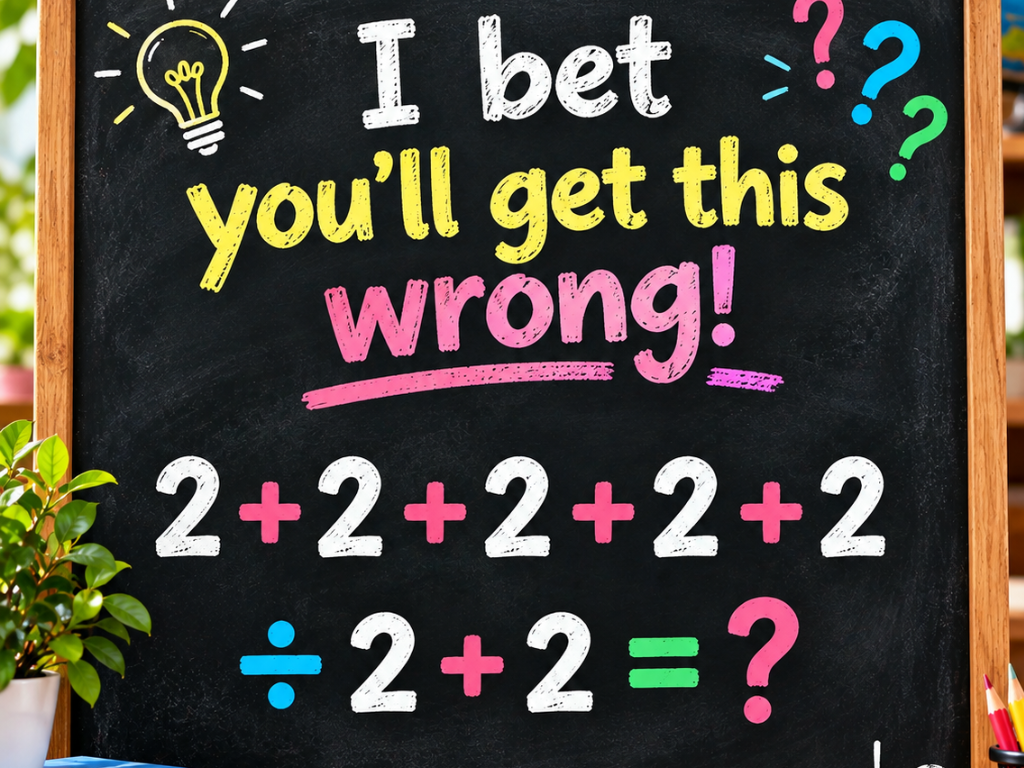
The Calculation That Confuses Everyone (And Why)
Here is the expression currently trending on the internet:
2 + 2 + 2 + 2 + 2 ÷ 2 + 2
Many people’s initial reaction is to add the numbers from left to right, as if reading a sentence. This often leads to an answer like 7, 6, or even various other numbers… but almost never the correct one. Yet, the rule that allows solving this calculation has been known since middle school; it has just been somewhat forgotten along the way.
The Fundamental Rule Forgotten Since School
In mathematics, not all operations have the same value or priority. There is a well-defined order to follow, in this exact sequence:
1. Parentheses take absolute priority.
2. Multiplications and divisions are calculated next, moving from left to right.
3. Additions and subtractions come last, also processed from left to right.

What often causes confusion is that multiplications and divisions share the same priority level. They should therefore be handled simply in their order of appearance, moving from left to right. The same applies equally to additions and subtractions.
A Clear Resolution, Step by Step
Let’s revisit the expression in question: 2 + 2 + 2 + 2 + 2 ÷ 2 + 2
There are no parentheses here. So we first locate the division:
2 ÷ 2 = 1
We replace this value in the expression:
2 + 2 + 2 + 2 + 1 + 2
Now, we proceed with the addition, from left to right:
2 + 2 = 4 → 4 + 2 = 6 → 6 + 2 = 8 → 8 + 1 = 9 → 9 + 2 = 11
The correct answer is therefore 11, not 7 or 12.
Why Does Our Brain Get Tricked So Easily?
Three cognitive biases explain why we make these frequent mistakes. First, we read the expression too quickly and add all the numbers without observing the priority rules. Next, we tend to imagine parentheses where none exist, which distorts the calculation. Finally, many incorrectly believe that multiplication always comes before division, even though they actually share the same status.
The Advice to Avoid This Mistake Forever
Before starting a calculation, take a moment to identify all multiplications and divisions. Solve them in the order they appear. It is only after completing these operations that you can continue with additions and subtractions. If the expression seems confusing, mentally add parentheses to clearly visualize the order of priority: this technique makes all the difference.
The next time a “simple” calculation puzzles you on social networks, you will know exactly how to respond.
