
Lina’s room has remained frozen in time, as if she had left just yesterday: colored pencils scattered across the desk, an unfinished drawing of a sunflower, the fairy lights still hanging on the wall, and on the bedside table, a half-finished embroidered bracelet for “mom.” I pass by this space like a ghost, unable to truly enter, yet also unable to close the door behind me.
My husband, Julien, survived the accident. His body heals slowly, but his eyes remain haunted by pain. He murmurs her name in his sleep, wakes up with a start, and blames himself endlessly for having driven that day. We carry together this heavy burden of silence, guilt, and an aching void that fills every corner of our home.
As for me, I simply pretend: I make the coffee, look absentmindedly out the window, breathe. And nothing more.
The Morning Oslo Knocked on the Door
That day, I was sitting at the kitchen table, my hands wrapped around a mug that read “Best Mom in the World,” a gift from Lina. The coffee had long gone cold, but I couldn’t bring myself to take a single sip.
Then, a strange sound caught my attention:
scratch, scratch, scratch.
It was neither a bark nor a plea for treats, but a desperate, anxious, almost panicked scratching. Our dog Oslo, Lina’s loyal companion, stood at the garden door, persistently insisting.
My heart raced, and without thinking, I stood up.
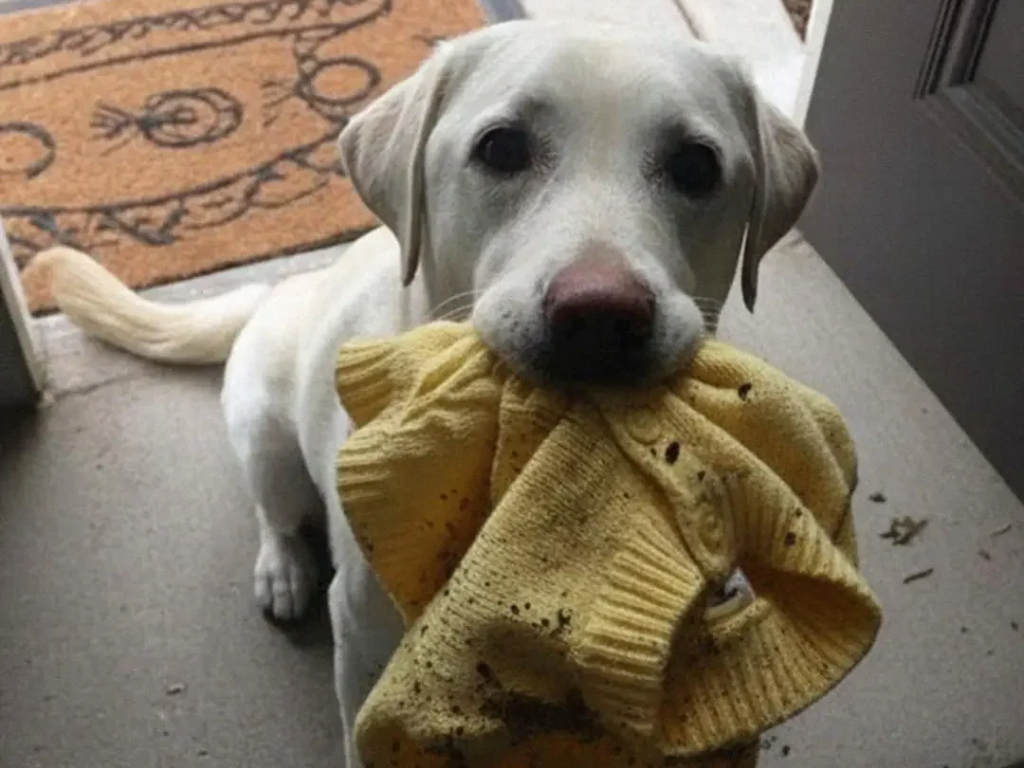
When I opened the door, Oslo was there, ears perked, eyes locked on me, motionless as if frozen. In his mouth, a piece of yellow fabric.
At first, I struggled to understand. Then my mind connected the dots with what I was seeing:
A yellow sweater.
Her yellow sweater.
The one that lit up her face like a ray of sunshine. The one she wore in so many photographs—at the park, at school, sketching on the living room rug.
My legs weakened.
“This can’t be…” I whispered, trembling.
As I reached to take the sweater, Oslo quickly withdrew it back into his mouth and dashed to the far end of the yard, constantly looking back to check if I was following.
Without hesitation, I hurriedly slipped on my clogs and ran after him, without a coat and without thought. I simply felt a deep intuition that something crucial was about to unfold.
An Old Shed and a Well-Kept Secret

Oslo slipped through an old gap in the fence, the one Lina used during summer to go play in the vacant lot next door. I had not passed through that opening in years.
He led me to an old abandoned shed, its creaky door hanging crooked, releasing a scent of dampness and dust.
Inside, in a dark corner, a curious “nest”: not a pile of twigs but a heap of clothes I knew intimately:
- a purple scarf,
- a blue hooded sweatshirt,
- a small white school cardigan.
All carefully stacked.
At the heart of this makeshift refuge, a gaunt calico cat curled, surrounded by three tiny kittens breathing peacefully. Oslo then placed the yellow sweater close to them, as if completing a puzzle.
And suddenly, everything became clear.
This sweater wasn’t the one Lina wore the day of the accident, but its exact duplicate—the other one I had bought “just in case.” Lina must have brought it here, along with her other belongings, to set up this sanctuary for the cat she had rescued.
My daughter had been coming here secretly, bringing food, water, and clothes to warm this fragile little family. She had created this haven without telling us, simply out of kindness and love.
This was Lina’s last project, her final mission full of tenderness, nestled within this forgotten shed.
When Love Keeps Flowing
I returned home with the cat, her kittens, and faithful Oslo by our side, holding Lina’s sweater close to me. I improvised a cozy little nest for them in the living room, right next to my daughter’s favorite armchair.
When Julien came downstairs, he found us gathered around this new little family. I told him in detail what Oslo had revealed to me, what Lina had patiently built without our knowledge.
For the first time in weeks, I saw him gently stroke a kitten.
“She really had a huge heart,” he murmured, moved.
Over the following days, feeding the cat and watching the kittens grow became our ritual—a fragile but strong thread reconnecting us to life.
In the evenings, I finally managed to step into Lina’s room, tie her unfinished bracelet around my wrist, gently open her sunflower notebook… and shyly smile through my tears.
The kittens, the dog, the rescued cat: they replace nothing, do not heal the pain, but they are like an extension of her heart, living proof that her gentleness continues to express itself in our home.
That night, for the first time since her departure, I slept without nightmares, comforted by this certainty: even when everything falls apart, love always finds a way, and the strength to carry on after loss can sometimes arise from the simplest acts.
