
A Visual Puzzle That Demands Your Full Attention
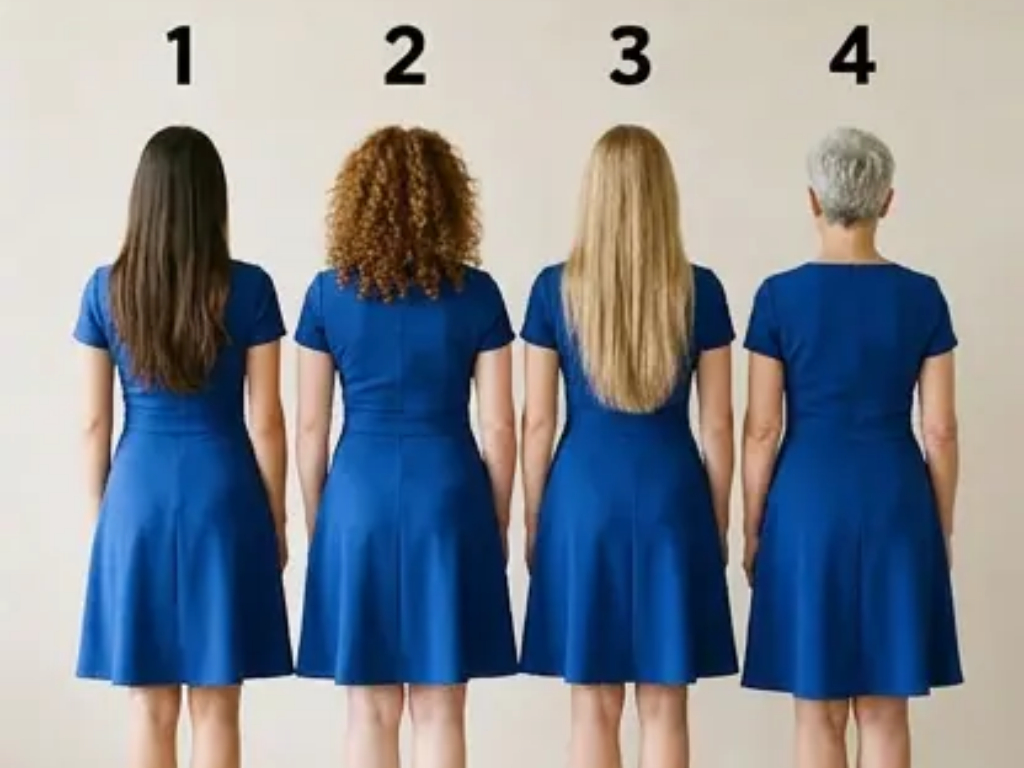
The challenge seems straightforward: four women are shown from behind, numbered 1 through 4, with their faces completely hidden. Only their hair, silhouettes, and posture are available to help you guess which one is the youngest.
But the trick lies in this apparent simplicity.
Woman number 1 sports long, dark, and perfectly straight hair—a style often associated with youth. Number 2 stands out with a thick mass of curly hair, full of volume. Woman number 3 has light-colored, medium-length hair, carefully styled. Finally, number 4 has short gray hair, which naturally leads one to assume she is the oldest.
Yet, the answer is not so obvious…
How Our Brain Plays Tricks on Us


These kinds of puzzles exploit a well-known mechanism in our cognition: mental shortcuts. Instinctively, we make a simple equation—gray hair means advanced age, long hair means youth—which can easily mislead us.
Nowadays, gray hair is very trendy, especially among young women who adopt it confidently and with a modern edge. This cultural shift makes this criterion completely obsolete when judging someone’s age.
Another subtle clue lies in their posture: woman number 4 stands upright with a straight back and an exposed neck, conveying energy and vitality. In comparison, the others appear to have a more relaxed posture. How a person holds themselves can actually reveal far more than their outward appearance.
This shows that sometimes you need to look beyond the obvious to gain clearer insight.
The Critical Factor You Must Not Miss
To decode this image correctly, it’s essential to observe every detail before rushing to a conclusion. Comparing the silhouettes, woman number 4 appears to be the most energetic. Her head carriage and firm posture suggest an intact vitality.
Conversely, the others have a slightly less assured manner—subtle, but enough to cast doubt.
The final answer to this puzzle points to woman number 4: despite her gray hair, she is actually the youngest.
It is precisely this reversal of expectations that makes the puzzle so captivating and insightful.
Why Do 90% of People Get It Wrong?
Simply because they judge in an instant.
Our brain is accustomed to quickly categorizing for the sake of speed, which is effective in everyday life. But when it comes to a visual puzzle, this snap judgment turns against us.
We often rely on a single visible detail without taking the time to examine the image as a whole. This type of puzzle serves as a reminder of how deceptive appearances can be.
It’s like assuming a complicated dessert requires extraordinary skills, when in fact, a few well-chosen ingredients and good technique are enough.
The Unexpected Benefits of Visual Challenges
Beyond simple enjoyment, these little puzzles sharpen our attention and critical thinking. They encourage us to slow down, observe carefully, and question our initial impressions.
Just a few minutes spent scrutinizing the image can awaken curiosity and train the eye to discover clues invisible at first glance.
And let’s admit it: there is a genuine satisfaction in guessing the right answer when everyone else is wrong.
So, were you among those who bet on number 4 from the start, or did your preconceived ideas lead you down the wrong path?
