
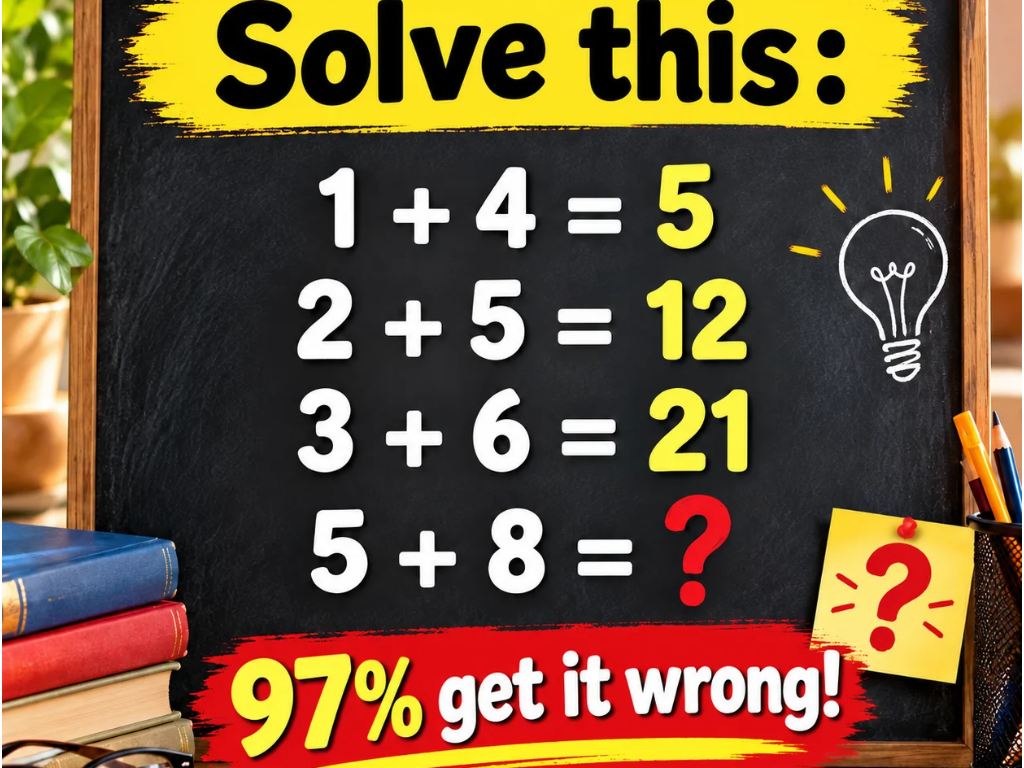
At first glance, this problem seems simple, almost childlike: just a few additions lined up one below the other, nothing complicated… Yet, thousands of people find themselves stuck or come up with different answers. This mathematical puzzle, which has become a viral sensation, fascinates by its ability to unsettle our usual ways of thinking and push us to consider things from a different perspective. What if there wasn’t just one correct answer, but multiple possible reasonings?
A Mathematical Puzzle That Disrupts Our Perception

Here is the puzzle presented:
1 + 4 = 5
2 + 5 = 12
3 + 6 = 21
5 + 8 = ?
The instinctive reaction is to perform a straightforward addition. But you soon realize that another logic is at work. This is precisely what makes this problem so captivating: it invites your brain to uncover a secret rule, to look for an underlying pattern.

This kind of exercise does not just challenge your mental math skills but primarily your power of observation, your ability to spot patterns, and to think differently. It’s somewhat like an investigation where you need to uncover a hidden rule. This mathematical puzzle that has gone viral perfectly illustrates a problem that pushes us to think outside the box.
The Most Obvious and Popular Logic
The most widespread method involves multiplying the first number by the second, then adding the first number to the product obtained.
For example:
2 + 5 = 2 + (2 × 5) = 12
3 + 6 = 3 + (3 × 6) = 21
Applying this same principle:
5 + 8 = 5 + (5 × 8) = 45
For many, this solution feels the most natural and coherent. However, it is not the only path to explore.
A Logic Based on the Previous Result
Another key is to use the result of the previous operation to find the next one. In other words, each line depends on the value calculated just before.
We observe:
1 + 4 = 5
2 + 5 = 2 + 5 + 5 = 12
3 + 6 = 3 + 6 + 12 = 21
Continuing with this logic:
5 + 8 = 5 + 8 + 21 = 34
This approach is appealing because it gives the impression that the series “remembers” its previous results. It builds up step by step, almost like a narrative advancing one stage at a time.
A Hidden Progression in the Results
Some puzzle enthusiasts have noticed another pattern: the results seem to follow a particular progression.
We have:
5, then 12, then 21.
The difference between 5 and 12 is 7,
between 12 and 21 it is 9.
This increasing progression follows a pattern of growing by 2 each time:
+7, +9, so next would be +11.
Adding 11 to 21 yields 32.
With this logic, the answer would therefore be 32. This represents another valid and plausible solution.
Why These Puzzles Are So Captivating

The virality of such problems on the internet is no accident. They captivate us because they challenge a certainty we have been taught since school: in mathematics, there is only one correct answer.
However, this type of puzzle goes beyond the final result. What matters most is the rigor of the reasoning applied. The interest lies not so much in the value found but in the logic that justifies it.
This makes for an excellent brain workout, stimulating creativity, intellectual flexibility, and open-mindedness. It teaches us to consider a problem from different angles rather than sticking to an automatic, mechanical method.
Ultimately, What Is The Correct Answer?
The most honest answer is that multiple solutions can coexist.
45, 34, 32… it all depends on the logic you choose to apply.
What truly matters is not having exactly the same answer as everyone else, but having succeeded in establishing a consistent rule, valid from beginning to end.
Ultimately, these puzzles are not just there to evaluate your math skills but primarily to test your ability to think differently and break free from habitual mental patterns.
