
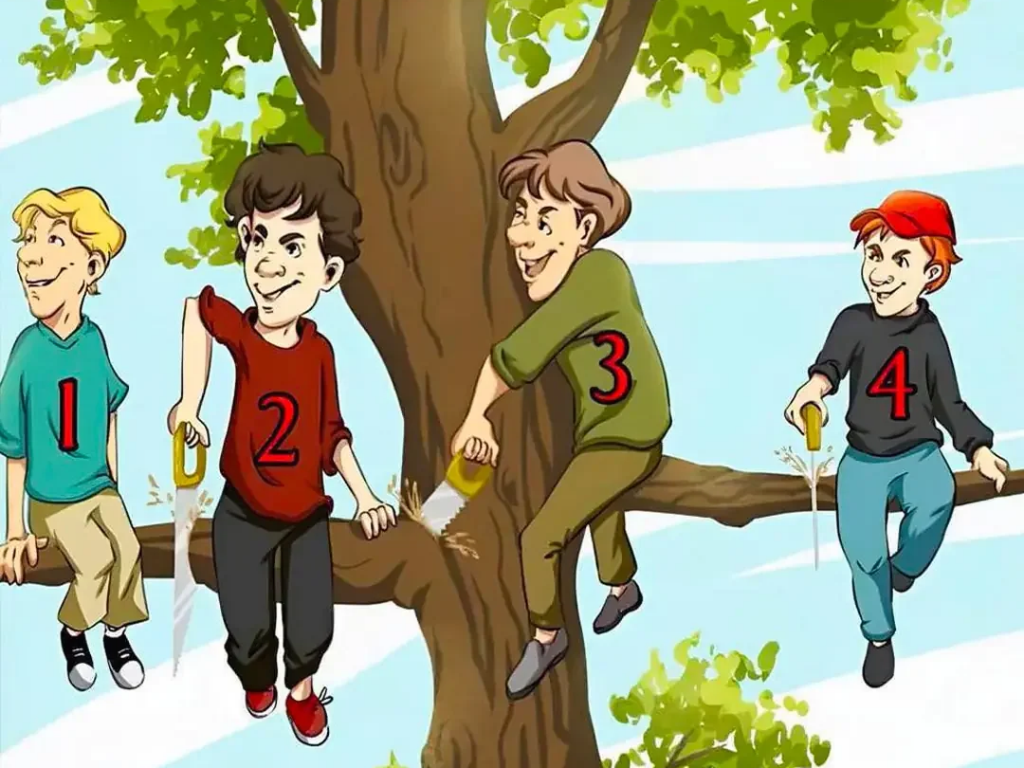
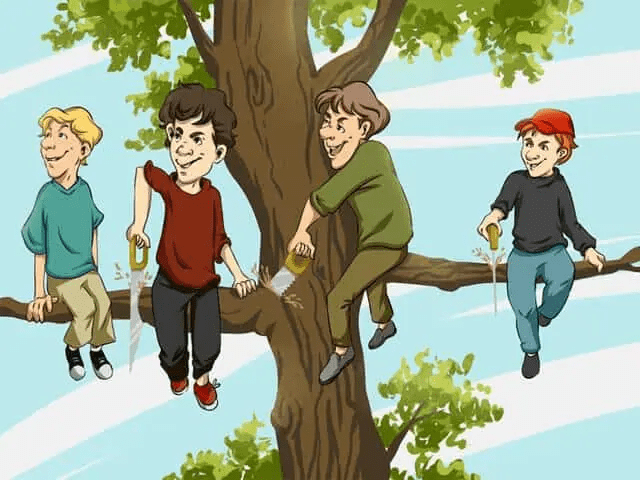
Four children are sitting in a tree, seemingly calm… until the arrival of a saw turns everything upside down. In just moments, this ordinary scene becomes a real puzzle. At first glance, the answer seems obvious, yet almost no one answers correctly. So, in your opinion, who is making the biggest mistake?
Before moving on, take a moment. Picture the scene in your mind. Listen to your intuition: who seems the most careless to you?
Why Our Brain Rushes to Judgment

In situations like this, our brain loves to move fast. It instantly spots a visible danger and draws a quick conclusion. This is a natural reflex, as we are biologically programmed to identify threats in the blink of an eye.

However, this visual test highlights precisely the hasty judgments we tend to make. It reminds us that our first impression is not always the most accurate or the most thoughtful.
In the image, each child plays a different role: one saws, another watches, a third seems to be bothering a friend, while the last remains distant. Is the biggest mistake necessarily the most dramatic one?
The Child Sawing the Branch He Is Sitting On
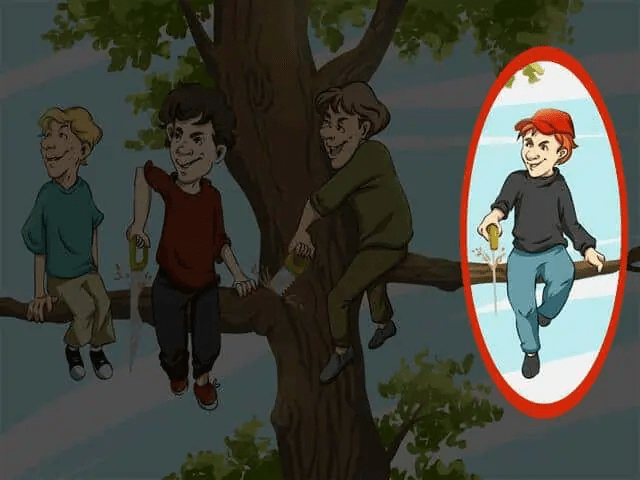
If you chose the boy wearing the red hat who is sawing the branch beneath him, congratulations: he is indeed the one making the most glaring mistake.
Why? Because his action immediately leads to an inevitable consequence. By cutting his own support, he inevitably causes his own fall.
He perfectly embodies what an impulsive reaction looks like: acting without considering the direct effect it will have on oneself. One might almost smile at such an obvious fact… Yet, this scene reflects many real-life behaviors.
A Metaphor for Our Daily Choices
How many times do we “cut the branch we’re sitting on” without even realizing it?
By taking on too many commitments until we are exhausted
By saying yes out of fear of disappointing others
By delaying a crucial decision to the point of weakening a situation
By ignoring a problem, hoping it will disappear on its own
In the moment, these actions seem insignificant. But in the long run, they can disrupt our daily balance.
This small visual challenge acts as a mirror: it exposes the difference between an impulsive reaction and a conscious decision.
What About the Other Children?
Some might think that the other children are also making mistakes: the one sawing a friend’s branch, or the one just watching without acting.
This is precisely what makes the exercise so interesting. It invites us to reflect on responsibility, the consequences of inaction, and the influence others have on our choices.
However, the gravest mistake remains the one that has a direct impact and is inflicted on oneself. The boy in the red hat is clearly acting against his own immediate interest.
And that’s often where the core of the problem lies: sometimes, we are our own worst obstacle.
The Hidden Lesson Behind This Riddle
This challenge is more than just a simple game to share with friends. It delivers a clear and universal message: before acting, one must take the time to observe.
In a world that keeps accelerating — with instant messages, rapid responses, hasty decisions — allowing yourself a moment of pause is a true advantage.
Observe. Breathe. Evaluate.
This three-step process can prevent many symbolic falls.
Next time you’re about to make an important decision, remember this image: a tree, a saw, four children… and a mistake that could have been avoided with just a bit more attention.
Sometimes, wisdom simply means checking which branch we’re on before we start sawing it.
