
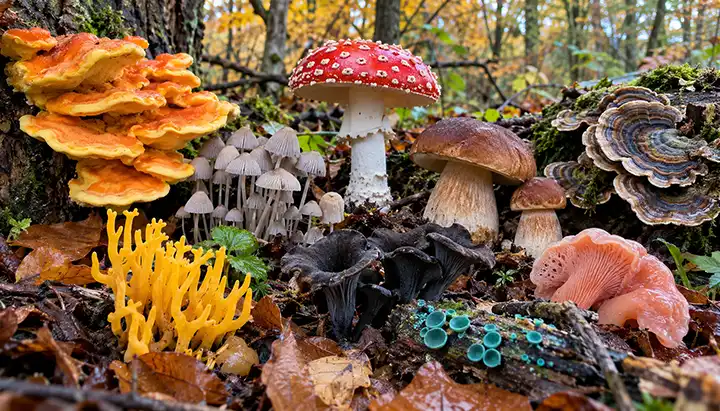
October is an especially rich time to explore forests. As temperatures begin to drop, autumn rains moisten the ground, and fallen leaves carpet the wooded trails, a fascinating world of mushrooms emerges.
Some mushrooms grow in the soil beneath oaks and beeches, others develop in colorful layers on fallen logs, form delicate clusters around old stumps, or take shapes so astonishing they almost seem unreal.
You might come across a vivid orange mushroom with shelf-like ridges, a tiny sprout with a cap resembling crumpled peach skin, or a magnificent red mushroom adorned with white spots.
However, while some autumn mushrooms are prized for their flavors, others are toxic, inedible, or simply too rare and precious to disturb.
October therefore offers an ideal opportunity to explore this hidden world, but it is crucial to be able to recognize what you observe.
Here, we present nine fascinating mushrooms to look for during your autumn forest walks, along with their habitats, distinctive features, and edibility statuses.
Essential Precautions Regarding Mushrooms
Important note: this article is intended solely for educational and nature observation purposes. It does not serve as a reliable guide to determine whether a wild mushroom is safe to consume.
Wild mushrooms can have toxic or deadly look-alikes, and their characteristics may vary depending on age, climate, and growth conditions. Photos, colors, common names, or brief descriptions are never sufficient to guarantee accurate identification.
Never consume a wild mushroom without formal and rigorous identification performed by a qualified local expert using appropriate identification methods. Some edible mushrooms need to be thoroughly cooked, and some individuals may still experience adverse reactions.
If you suspect mushroom poisoning, contact emergency medical services immediately. Do not delay action even before symptoms appear.
The following information on edibility applies only to correctly identified species, not to mushrooms you may think you recognize based on this article.
1. Sulphur Shelf (Laetiporus sulphureus)
Edibility: edible when young and thoroughly cooked, but with absolute caution.
Among the most spectacular mushrooms encountered in autumn is the Sulphur Shelf.
Its bright shelves, blending vibrant oranges and yellows, stand out sharply against the dark bark of aged trees.
Rather than having a distinct cap and stem, this mushroom forms clusters of overlapping fan-shaped layers, sometimes very large.
Its Morphology
Young specimens often show an intense orange upper surface bordered with yellow.
The underside is yellow, covered with tiny pores instead of typical gills.
When fresh, the flesh feels tender and meaty; with age, it becomes harder, paler, and brittle.
These large colonies can spread over several tens of centimeters of a trunk.
Habitat
The Sulphur Shelf grows on living or dead trees, primarily hardwoods such as:
- Oak
- Willow
- Cherry
- Horse chestnut
- Other deciduous trees
It can also appear on certain conifers, depending on the Laetiporus species.
Period of Appearance
Its fruiting peak generally extends from spring to autumn. In October, it can still be observed, especially in mild, humid weather, though it is often more abundant earlier in the season.
Consumption
Young Sulphur Shelves, correctly identified, are a culinary specialty when cooked thoroughly.
The popular name derives from their texture, which is similar to cooked chicken.
However, some people may experience digestive issues or allergic reactions.
It is strongly advised not to pick those growing on yew trees due to contamination risks, and caution is advised for those growing on certain conifers.
Interesting fact: this mushroom causes brown rot of wood, breaking down its components and leaving a characteristic crumbly structure.
2. Grey Field Cap (Coprinellus disseminatus)
Edibility: edible according to some, but generally not recommended.
Imagine hundreds, even thousands of tiny mushrooms growing tightly clustered on a rotting stump.
This charming sight is created by the Grey Field Cap mushrooms.
These delicate mushrooms are among the most enchanting autumn mushroom gatherings.
What Does It Look Like?
Their small bell-shaped caps typically measure between 0.5 and 1.5 cm in width.
They start off cream or light beige, then gray as they mature.
Their surfaces are finely wrinkled, almost like crumpled paper.
The stems are thin, pale, and very fragile.
Unlike many other ink caps, these do not dissolve into a black ink at maturity.
Where to Find Them?
They grow around:
- Decaying stumps
- Buried roots
- Fallen hardwood
- Moist wooded fringes
- Shady, decaying wood habitats
They can appear suddenly in great numbers after a heavy rain.
Season of Appearance
The Grey Field Cap develops from spring to winter, with a peak observation in autumn.
They are common throughout Europe and North America.
Edibility
Although some guides list this species as edible, its culinary interest is limited.
Its tiny size, fragile texture, and possible confusion with other small mushrooms make it unsuitable for gathering for consumption.
It is better admired in its natural setting.
Interesting fact: a single stump may host a true “village” of these mushrooms so dense that they cover its entire surface.
3. Fly Agaric (Amanita muscaria)
Edibility: toxic. Do not consume.
Few mushrooms are as immediately recognizable as the Fly Agaric.
Its bright red cap speckled with white spots seems straight out of a fairy tale.
It is also one of the most photographed mushrooms in autumn.
Description
The cap usually ranges from bright scarlet to reddish-orange, decorated with irregular white patches.
These patches are remnants of a protective veil that covered the mushroom when young.
As it matures, the cap expands and can flatten out.
The gills are white, and the stem is also pale, usually adorned with a ring and a swollen base.
Rain can wash away the white patches, so some Fly Agarics may not always show the classic appearance.
Habitat
The Fly Agaric forms mycorrhizal associations with several trees, including:
- Birch
- Pine
- Spruce
- Other suitable forest trees
It grows on the ground in forests and wooded moorlands.
Period of Presence
Its fruiting season spans from late summer to early winter.
September and October are often the best months to observe it in temperate forests.
Consumption?
No. The Fly Agaric is toxic and contains psychoactive substances such as ibotenic acid and muscimol.
Ingestion can cause vomiting, confusion, perception disturbances, agitation, drowsiness, and other severe symptoms.
While traditional uses exist, none guarantee that consumption is safe.
Interesting fact: this Amanita has become a universal symbol of fairy tales, enchanted forests, and traditional mushroom illustrations.
4. Black Trumpet (Craterellus cornucopioides)
Edibility: edible after certain identification and proper cooking.
The Black Trumpet is one of the most unique edible autumn mushrooms.
Its dark coloration makes it surprisingly difficult to spot, even in groups.
It is also called the “Horn of Plenty” or simply the “Black Trumpet” in various European regions.
Despite its dramatic name, this mushroom is highly prized gastronomically.
What Does It Look Like?
Its hollow stem forms a narrow, tapered trumpet shape.
Color ranges from charcoal gray, almost black, to deep black.
The inner surface is generally darker, while the outer side may appear gray and slightly wrinkled.
It has no gills beneath the cap because the cap merges with the stem.
Its dark hue and irregular form allow it to blend seamlessly among fallen leaves.
Habitat
It is mostly found in deciduous forests, especially beneath:
- Beech
- Oak
- Other suitable hardwoods
It often grows in groups on the forest floor.
Period of Appearance
Across much of Europe, the Black Trumpet fruits from summer to late autumn.
October is often particularly favorable, especially after rainfall.
Its presence may vary greatly from year to year.
Edibility
Yes, it is regarded as a choice mushroom in cooking.
Traditionally used in sauces, soups, and prepared dishes.
However, similar-looking species can be bitter or toxic, so reliable identification by a specialist is essential.
Interesting fact: the Black Trumpet can be nearly invisible when viewed from certain angles. Spotting a single specimen may suddenly reveal an entire colony hidden beneath the leaves.
5. King Bolete (Boletus edulis)
Edibility: edible and highly prized when well-identified and properly cooked.
The King Bolete is one of the most famous edible wild mushrooms in Europe.
Also known as Penny Bun, Porcini, or Cep, it is especially sought after for its rich flavor and firm texture.
Its rounded brown cap, supported by a thick stem, gives it the appearance of a small forest bread loaf.
Description
The cap is usually smooth and brown, reaching impressive sizes.
The stem is robust, light-colored, often swollen at its base, with a visible net-like pattern near the top.
The underside features a layer of tiny pores instead of gills.
These pores start out light in young specimens, turning yellowish to olive as they mature.
Habitat
The King Bolete forms mycorrhizal relationships with several trees, notably:
- Oak
- Beech
- Birch
- Pine
- Spruce
It is commonly found at forest edges, in grassy clearings, or on mossy ground.
Observation Period
Mainly from summer to autumn.
September and October are often the most fruitful months, especially following favorable rain.
Edibility
Yes, it is one of the most beloved edible mushrooms.
It has a long tradition in European cuisine.
However, boletes include some closely related species that may be bitter or toxic, so caution is necessary when foraging.
Interesting fact: in Italy, dried King Boletes are sold and used to enhance risottos, soups, and sauces.
6. Yellow Stagshorn (Calocera viscosa)
Edibility: generally considered inedible or of little culinary interest.
The Yellow Stagshorn looks more like a small piece of marine coral than a forest mushroom.
Its yellow or orange branches emerge from decaying wood, forming tiny antler-like structures.
On a dark, moist substrate, its bright coloration makes it one of the most colorful discoveries during an autumn walk.
Description
This species produces upright, branched forms, often bright yellow to orange-yellow.
Branches frequently divide near their tips.
Its texture is gelatinous, slimy, or rubbery, often slippery, distinguishing it from true coral mushrooms.
Where to Find It?
It grows on decaying conifer wood, such as:
- Rotting spruce stumps
- Decomposing pine
- Buried conifer roots
- Fallen conifer trunks
Sometimes it appears to grow directly from the soil when the wood is buried beneath the surface.
Period of Appearance
Present year-round, but autumn is especially favorable, with colors becoming even more vivid in wet weather.
Edibility
Not recommended for consumption.
Its lack of substantial flesh, rubbery texture, and limited gastronomic appeal make it unsuitable for table picking.
Interesting fact: the Yellow Stagshorn belongs to the jelly fungi family, distinct from the true coral mushrooms it visually resembles.
7. Turkey Tail (Trametes versicolor)
Edibility: not edible as a culinary mushroom due to its tough texture.
The Turkey Tail is one of the most colorful and widespread polypores on dead wood.
Its name comes from the concentric, multicolored bands that resemble the fanned tail of a wild turkey.
Individual hues can range from brown, cream, gray, orange, and blue-gray to nearly black.
Appearance
It forms thin, semicircular shelves, often clustered in dense bouquets.
The upper surface is marked by distinct color rings.
Its texture is hard and leathery, unlike soft mushrooms.
The underside is whitish and covered with very fine pores.
Habitat
It commonly grows on:
- Fallen hardwood branches
- Dead trunks
- Old stumps
- Decaying logs
It is mostly found on broadleaf wood such as oak or beech.
Season of Appearance
Visible year-round, but easy to observe in autumn and winter when the forest floor is cleared of leaves.
Edibility
The Turkey Tail is not consumed as a traditional mushroom due to its extreme toughness.
However, it has a long history of use in traditional medicine, and some extracts are under scientific study.
That said, this does not imply that its wild use is a recognized medical remedy.
Interesting fact: this fungus plays an essential ecological role by decomposing dead wood and recycling nutrients in forests.
8. Green Elf Cup (Chlorociboria aeruginascens and related species)
Edibility: not recommended for consumption.
The Green Elf Cup is one of the most surprising mushrooms of the woods.
Instead of large caps, it produces tiny blue-green cup-shaped fruiting bodies on dead wood.
Even more astonishingly, it colors the wood with a vivid turquoise hue, striking to the eye.
What Does It Look Like?
Its fruiting bodies are very small, often less than one centimeter in diameter.
Miniature, shallow cup- or bowl-shaped, they display a bright bluish-green to turquoise color.
The surrounding wood takes on an intense blue-green tint that persists even after the mushrooms vanish.
Habitat
It mainly colonizes decaying hardwood, particularly on:
- Oak
- Beech
- Hazel
- Other fallen deciduous branches
It favors moist, decomposing wood.
Period
The distinctive wood coloration is visible year-round, but fruiting bodies are less often seen, occurring more frequently during moist autumns.
Edibility
Not recommended as an edible mushroom.
Very small and with no recognized role in wild gastronomy.
Two similar species, Chlorociboria aeruginascens and Chlorociboria aeruginosa, are very close and require microscopic examination for differentiation.
A Fascinating Historical Link
The green pigment produced by these fungi is called xylindein.
For centuries, this stained wood has been sought after for marquetry and inlay work in craftsmanship.
Interesting fact: the turquoise wood coloration can be spotted long before the small fungal cups become visible.
9. Wrinkled Peach (Rhodotus palmatus)
Edibility: inedible. A rare species to respect and not disturb.
Among the listed mushrooms, this is certainly the most unusual and almost surreal.
Its delicate coloring between pink and orange, combined with a uniquely wrinkled surface, makes it one of the most visually remarkable mushrooms in European forests.
Unlike conventional mushrooms with a…


